


The Microfinance Myth with David Whitehouse
Watch the episode
Summary
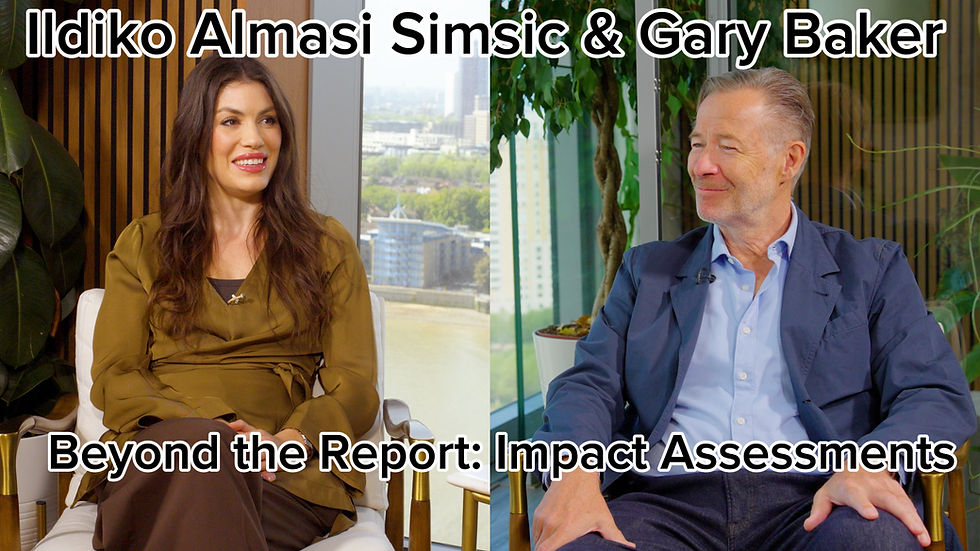
In this episode of the No-Nonsense Sustainability podcast, host Ildiko Almasi Simsic engages in a critical discussion with journalist David Whitehouse about the realities of microfinance. Whitehouse, with his extensive background in financial journalism, shares insights into how microfinance, once hailed as a solution to poverty, has evolved into a system with significant drawbacks.
The conversation delves into the history and evolution of microfinance, highlighting its transformation from a community-focused initiative to a high-yield financial service. They discuss the crisis at the World Bank Group's IFC and the resignation of CAO Director Janine Ferretti over issues in Cambodia, as well as the rise of digital lenders and their impact on borrowers.
Throughout the episode, Whitehouse argues that microfinance often fails to alleviate poverty and can lead to significant harm, such as over-indebtedness and loss of assets. The discussion concludes with a call for more equity investment in SMEs as a more effective approach to fostering financial inclusion.
Highlights
Microfinance has evolved from a community initiative to a high-yield financial service.
David Whitehouse critiques the effectiveness of microfinance in alleviating poverty.
The World Bank Group's IFC faced a crisis over microfinance practices in Cambodia.
Digital lenders are increasingly using social shaming tactics to enforce loan repayments.
Microfinance often leads to over-indebtedness and asset loss among borrowers.
There is a call for more equity investment in SMEs instead of microcredit.
The episode questions the ethical implications of current microfinance practices.
Key takeaways
1. Microfinance, initially seen as a poverty solution, has significant drawbacks and can harm borrowers.
2. David Whitehouse highlights the evolution of microfinance into a high-yield financial service.
3. The World Bank Group's IFC faced controversy over microfinance practices in Cambodia.
4. Digital lending practices have introduced new challenges, such as social shaming for loan enforcement.
5. The episode suggests equity investment in SMEs as a better approach to financial inclusion.
Timestamped breakdown
[0:01] — Introduction to the Podcast: Ildiko Almasi Simsic introduces the No-Nonsense Sustainability podcast and the episode's focus on microfinance.
[0:43] — Guest Introduction: David Whitehouse, a financial journalist, joins the discussion on financial inclusion and microfinance.
[1:47] — Defining Financial Inclusion: Whitehouse explains financial inclusion as a euphemism for microfinance, highlighting its components and issues.
[4:21] — History of Microfinance: Discussion on the origins of microfinance and its evolution from a US government initiative.
[10:05] — Cambodia Microfinance Crisis: Analysis of the IFC's role in the microfinance crisis in Cambodia and the resignation of Janine Ferretti.
[19:04] — Effectiveness of Microcredit: Whitehouse discusses studies showing limited impact of microcredit on poverty alleviation.
[26:12] — Changes in Microfinance: Whitehouse observes the shift in microfinance from a social mission to a financial service.
[27:56] — Digital Lending and Social Shaming: The rise of digital lending has introduced social shaming tactics for loan enforcement.
[35:30] — Concluding Thoughts: Discussion on the need for equity investment in SMEs as a better financial inclusion strategy.
Edited transcript
[music] [music]
Hi everyone. Welcome back to the No-Nonsense Sustainability podcast. I'm Ildiko Almasi Simsic. This show isn't about saving the planet with corporate slogans or glossy brochures. We leave the PR spin at the door. We're here to talk about real communities, real infrastructure, and the future we're actually building together with the people shaping it and the critics testing it. No jargon, just real talk. In development finance, there's not a lot of world more interesting and lucrative than financial inclusion. It was only fair that we have an episode where we dismantle this buzzword. Joining me today is David Whitehouse, a financial journalist for over 30 years based in Paris. David has been writing for Bloomberg News and The Africa Report. He holds a PhD in Rwandan history, and he's the author of The Dark Side of Development Substack. Welcome to the show, David.
Thank you so much, Ildiko, and it's great to have the chance to be on your podcast.
Yes, as you know, we have Bob the Buzzer here, and every episode is focusing on the buzzword. So, this time I would like to ask you to explain what financial inclusion is without any technical terms or jargon in 60 seconds, so even people in our audience who are less familiar with it could understand. Are you ready?
I'm ready.
Okay, let's go. What is financial inclusion?
Financial inclusion is a euphemism for microfinance. Microfinance has three components: Microcredit, which is loans to people in developing countries, small loans, microinsurance, and savings. Now, microcredit is much more profitable than either insurance or savings for poor people. And from the 1980s that is it became an extremely popular form of anti-poverty intervention in developing world. The problem was that it wasn't very effective and on many occasions has been shown to cause considerable harm to some of the people who borrowed at very high interest rates. Now, as these problems became clear, there was a retreat away from using the term microcredit or microfinance and the new buzzword became financial inclusion. But it's basically, in my opinion, a euphemism, which says we can't tackle poverty through microfinance, but we can still include people in the financial system. But it doesn't mean it's any more effective than microfinance. It's just a relabeling.
Okay, so based on my project work, financial inclusion also included, not just like banking the unbankable because let's be honest, when we're thinking about financial inclusion and microfinance specifically, there is this incredible narrative that if you could only provide the financing for these budding entrepreneurs, they could just get themselves out of poverty. That's how, you know, Muhammad Yunus with the Grameen Bank started, but somehow we ended up in a situation as you sat today where we have predatory practices, we have high interest rates, and are we really being inclusive with this finance? So, before we look into the current scandals in IFI world, can you walk us through the evolution and the structure of microfinance?
Well, microfinance was first designed first conceived of by the US government in the 1960s as a method to contain the threat of communist expansion in Latin America. It didn't start with Yunus in Bangladesh by any means. Yunus did his PhD in the US as a Fulbright scholar and became immersed in the American worldview as part of that, which is of course one of the aims of the Fulbright system. When Yunus went back to Bangladesh and started providing small microfinance loans, this was a big breakthrough. This is in the 1980s. This is a breakthrough for the marketability of microcredit because now you have this charismatic figure in Bangladesh, comes from Bangladesh. Giving out these small loans. But you used the word incredible as a narrative and incredible is I think that the word. I mean, how many of us actually want to be entrepreneurs? I've seen estimates that about 8% of people in developed countries have the long and complex set of skills that you need to be a successful entrepreneur. 8% of people.
Yeah, that's not very many.
Countries, no, and in developed countries we have so many advantages in terms of education, infrastructure, stable rule of law, etc. In developing countries, these things are often absent. So, 8% would be a really optimistic figure for the global south. But, we persist in this idea, or some have persisted in this idea that there's a budding entrepreneur inside us all, and there's just no reason to believe that. It's a simple piece of fiction.
Yeah, I think it also comes down to what we call a company or a business. Because a lot of these community-based concepts, these initiatives in Africa, they started off as oh, there's a lady in the village, and she bakes amazing pastry. Let's give her $5,000. So, now she can hire her sister and her auntie, and they can make more pastries, and they can sell the pastry. So, often when we define what that entrepreneurship is, it means very different things given the context. How do you see this comparison between developing country micro-entrepreneurship compared to, for example, what you see in the west where everyone has like a side hustle, and you're selling courses and digital tools on the internet?
Well, it's not even as if we can say it's not even as if anyone can provide a textbook on how to be an entrepreneur that would be globally valid.
I wish there was such a textbook.
Well, it's impossible. It's not going to happen. I mean, if you look at if you think of America in the 19th century, the Soviet Union as it collapsed and turned into the successor states, and if you think about Africa today or Latin America today or Cambodia today, the skills you would need to be a successful entrepreneur at these different times and places would be rather different. There's no catch-all solution to this. So, the idea that entrepreneurship can be taught in a systematic way across time and space is another piece of fiction which it should I mean, a moment's thought should be enough to dispense with the idea, really.
Yeah, but this is more if the money's coming from the institutions. What happens to those solidarity group lending initiatives, crowd sort of like crowdsourcing in small communities where everyone donates and then at the end of the month or the year, the amount goes to certain households.
Yeah.
Yeah. I mean, people across the whole world have had financial solutions long before there was ever Western banking. I mean, there are rotating savings and credit associations have been around for hundreds of years before Western banks. And they exist across They have existed across the world under a great variety of names. And they have been successful to relative degrees, but they don't all They don't operate on an institutionalized basis. They are small community trust focused groups. And that's something that those kinds of projects haven't really had the kind of support that microfinance has had in recent decades, mainly because the World Bank became a leading proponent of microfinance and community local community-based solutions have really stood at the margins.
Yes, and I think it is this World Bank Group crisis or a scandal over the suburb of 2026 that prompted us to have this discussion about the systemic issues within microfinance and this financial inclusion umbrella. So, just to like recap, the IFC Board of Directors took this unprecedented step when they officially overruled the findings of their own independent watchdog, the Compliance Advisor Ombudsman or CAO, regarding severe human rights harms and forced land sales tied to IFC-funded microfinance institutions in Cambodia. The board declared that they have found no policy non-compliance, and they said that the unborrowers fall outside of the IFC's sustainability framework. As a result, the CAO Director General Janine Ferretti resigned. Some say it's in protest, and the bank subsequently ordered the freeze on CAO microfinance consumer protection investigations. Can you walk us through this case and like show how microloans could lead over 167,000 forced land sales in Cambodia? And what does it mean when a bank's board retroactively decides that these unborrowers don't count as affected people?
Well, the story starts in Cambodia, but it's important much more broadly, as you say. Cambodia saw a massive build-up in microfinance lending to an absolutely absurd extent. Human Rights Watch calculates that by 2024, there was 18 billion of microfinance debt in Cambodia, which is absolutely absurd for such a small poor country. And it's actually been calculated in the US, if you were to adjust the incomes, adjust this for the fact that Americans have higher incomes than Cambodians, this would equate to $328,000 for every single American adult. Now, that is absolutely insane.
Yeah, but that's what the microfinance lending system did to Cambodia. Now, not surprisingly, the IFC The World Bank's IFC was part of financing the lenders in Cambodia who provided these loans. And in 2022, there were a series of complaints made by Cambodian final borrowers about the harms that they suffered. Now, IFC management in 2022 didn't want to let the ombudsman investigate this. They tried quite hard to stop it from happening.
Who did these people complain to?
They complained to the ombudsman. The CAO ombudsman. And finally, the ombudsman was allowed in 2023 to go ahead with the investigation. And the report, which is an extremely detailed and compelling report, which I recommend that everyone reads who's interested in microfinance, was completed in October 2024. The IFC management responded to this by saying, as you have explained, that IFC policies were not breached and that they're not taking any more microfinance complaints either from Cambodia or anywhere else.
So, CAO said that the complaint is eligible to be investigated. And what were the findings of their investigation?
Oh, the findings show a range of harms such as borrowers having to take kids out of school, having to sell land, having to sell other productive assets. A range of harms are proved to have been suffered. But the IFC simply at the management level is washing its hands of it. What they want to do to do is to return these disputes to a local dispute rep mechanism in Cambodia. But the borrowers concerned, almost all of them have refused to be part of that process. They don't want it to be they don't want the dispute to be taken up by a local mechanism because they don't have confidence in any such mechanism.
Yeah. Yeah, that's very often the case. I am wondering how how does a board get to that point where they re-evaluate a CAO decision. Because when I was working there, CAO was independent. They had their ways and mechanisms. We've had people from EBRD accountability mechanism walking us through detailed steps on like what is it that they're looking at and how they're trying to be impartial and not just, you know, protect the bank, but protect the people and the the legacy or the ideals of the institution. So, every time I had a CAO complaint on my project and it went through the either mediation or investigation, whatever the findings were, we kind of accepted that. So, why did the board not accept the CAO findings in the Cambodia case? Is it because of the seriousness of the harms, the number of the people affected, or the local like news or awareness of the issue?
Well, I don't think the CAO was ever really independent. When it was set up, there were calls for a truly independent mechanism which would not be answerable to management. And that wasn't done. So, the CAO always had quite a constrained mandate in terms of what it could actually do. Why has it been overruled? Why was it overruled in this case? It's because of the precedent that it would set would open up potential liability for the IFC and the World Bank wherever microfinance has been financed. So, the liability would be the potential future liability would be large and unquantifiable. Basically, it would cost expose them to an awful lot of potential cost.
Yeah, I mean, it has been a known issues with financial intermediary projects in the IFI world that often these microfinance institutions, they have this like big bowl and different lenders pour different amounts into that bowl. So, at the end of the day, they're not really changing the way they operate on a day-to-day basis. They're just allocating certain loans to certain institutions. So, this blind spot, so to speak, has been relatively well known in the IFI world. but it does not alleviate any human suffering in Cambodia or in other countries where it happens. It just makes sure that the bank's balance sheet is clean. How can institutions claim to have environmental, social, human rights governance standards when the primary lending channel is structured to be an unauditable blind spot?
Well, I don't think they can. I mean, the World Bank and the IFC decided that they wanted to finance microcredit and they don't want to take responsibility for the harms that it's been shown to create. So, I mean, they can dress it up how they like and they have an awful lot of people working very hard to dress it up, but those are the facts.
Yeah. And I think when we're looking at microfinance, there's the two distinct, like, ways to look at it. The one of the products is geared towards personal use. So, there might be some IFI money coming in through microfinance institutions for, like, personal use loans for household items, electronics. Although, I've seen less of this and as you've said, most of this microfinance is geared towards microentrepreneurship. What are the findings by economists and people on the actual ability of this microcredit to reduce poverty?
Well, the there's a study of studies that has been produced, which Duvendack in the UK is a leading academic on this. But basically, what we see is a bell curve. So, the story for the most part is not very dramatic at all. For the great majority of people who borrow, who take microfinance loans, there isn't any impact that we can measure. So, for most people, nothing particular changes just because they take a small loan. However, at the ends of the bell curve, some things do change. Now, it is absolutely correct to say that there are some well-established, small and medium-sized companies, SMEs, there are some that benefit from taking a loan. And I think I could have told you that as a as a teenager in the 1980s before all this stuff started. Yes, some businesses will do better if they're able to borrow some money. Okay. And at the other end of the bell curve, we have people who are quite clearly harmed by taking on too much debt. And the harms that they suffer include losing their land, losing their houses, and in India in 2010, there was a wave of suicides. There's no limit to how bad it can get really if you borrow too much money. But in the middle, for the most part, nothing that is really measurable is happening for most people. I would argue that that is in fact too optimistic because something is in fact happening. because for one thing microcredit is pro-cyclical. It increases the amount of debt in the economy, so it tends to strengthen the economic cycle. So, you get a bigger boom and a bigger bust. But not much is happening for most people at the moment because there isn't a global financial crisis. But there always will be another global financial crisis. They've always happened they've always happened since the start of global capitalism and then we've never found a way to stop them. So, the one safe bet for the future is that there will be another global financial crisis. The last time we had one the amount of microfinance debt was much smaller than it is today. So, what happens in the next global financial crisis to small businesses who have taken out expensive debt you don't have to be a genius or even an economist to see that there's going to be an awful lot of trouble for people who up till now are not showing any decisive change in their circumstances because of microcredit.
But then how is it that whenever you look at a development bank, impact investing, these brochures are full of positive impact created by microfinance? Are they cherry-picking individual cases to prove their point? Or is there something in there that they're doing so well and so differently from the others that it actually makes a difference for people?
Well, they're certainly cherry-picking. I mean the people who produce these reports are paid to do so. 60 Decibels is a clear example. They are a marketing services organization. They produce glossy write-ups of the cherry-picked success stories. But Yeah, I mean, it's it's it's a form of marketing. It's a form of communication. It doesn't tell us about what's really going on across the board amongst all of the borrowers and amongst the wider economy.
Yeah, I know that that might be fair. I think some of the institutions recognize that providing the finances alone is not enough. So, some of these institutions work with the microfinance or financial intermediary companies to offer what they call Yeah, capacity building. I should bust myself for this, but basically giving people skills, whether that's financial literacy, whether that's business, entrepreneurship. There might also be opportunities for networking so that clients of the same microfinance institution could, you know, like do business with each other and try to help. Based on the studies that you've read or your experience, how effective are these in-kind training, non-financial support type initiatives that might accompany the microcredit?
Well, there's a recent study out of Morocco where they tried to work out and this is funded by the Gates Foundation. It was published, I think, in August or July this year. They tried to work out why don't people in Morocco want microcredit very much. They got two new products. One of the products gave them a grace period, so you have longer to start before you start repaying, and the other one was adjusted so that your repayments are tied to your cash flows. Okay, fair enough. People seem to like those a bit more, but they didn't want to take any more loans, even if there was more financial education and information provided, there was no actual impact on the take-up of loans. Although people would say, yes, I'll I would prefer a grace period. I mean, who wouldn't prefer a grace period on a loan? But the actual effect on take-up was was nothing.
And why is that?
Micro people because people in Morocco don't want microcredit on the whole, most of them.
But is there because are there like more traditional mechanisms exist to obtain money? Are they not entrepreneurial? Like what Did they Did the society find out why?
Know. I don't know, but they they just don't want it. They don't see they they don't they don't want to buy expensive debt if they don't need to, and and and who can blame them?
Now, that's very interesting. So, based on based on your 30 years of writing about it, how did you see the microcredit change over time? Because certainly, I believe in continuous improvement, so even if the system is not perfect today, I assume it's much better than it was in the '80s or even '90s or early 2000s. What do you see as the main trends and the big changes over the decades?
Well, there been some big changes, though. I don't think there's I mean, I would say it's got worse if anything because there was a kind of social mission aspect to microfinance in in the earlier stages. Like I I don't think I I I don't honestly think that people financed that amount of microfinance debt in Cambodia cuz they thought they would get rich. I I just can't believe that. There was a social mission involved. People thought they were doing some good even if it was very misplaced in my opinion. There was a good intention early on. But but financial services have a logic of their own. They have an industrial logic of their own. So microfinance has become more and more just another specialized kind of financial service. So it will behave more and more like standard banking services. And that's that's a trend which will continue in the future. Another big switch has been the rise of digital technology has meant that the old forms of social shaming have been replaced by newer forms of digital social shaming. So early on in microfinance, a loan would be provided to a group of people and the group would be responsible for repaying. So if someone didn't chip in or wasn't able to chip in, then they would suffer very serious social shame in some cases within that group and the people who were who were associated with that group. These days, microfinance has evolved and people are individually responsible for their loans. It's not a group model anymore. Okay, fair enough. So what does this mean? In Kenya, for example, it has meant the rise of digital social shaming. When people have been signing up for their microfinance loans in recent years. They have often given authorization to the digital lender to harvest their contacts. So, as soon as that person then that person then falls behind on their loan, it's not just it's not just them who start getting digital notifications. It's all their contacts, which might be family, work friends, etc. All these people will know that the person has fallen behind on their loan. And that's
That's crazy.
Well, Kenya is taking steps to regulate and outlaw this, but in many cases the harm has already been done.
Yeah. No, so yeah. This is crazy that they could just text your contacts that you're behind on your payments.
It's just another It's just another detail that the funders don't seem to have thought about until it was too late.
And do you think technology and the leapfrogging that we've seen in Africa where like the global south developing countries skipping traditional banking systems for mobile payments and mobile banking, do you see this as a catalyst that led to even more microcredit being dispersed?
Well, the thing about the rise of digital lending is that it does not If If you lend to a small merchant in Africa, if you give them a digital loan, you will get some success stories. Some businesses will use digital loans and digital technology to scale faster than they otherwise could have, which is all well and good. But the problem with putting these out as success stories is that we don't talk about the losers from that process. Now, if you're, I don't know, supply If you are a supplier in some market in Africa, if you're supplying chairs or garden tools or whatever it is, whatever your product is, and you're using digital finance and digital distribution, you may well succeed faster. But the amount of demand for in that industry has not actually increased. So, you're just displacing older players who are not as digitally savvy. If the amount of demand in the economy hasn't increased, then all we're doing is redistributing the existing demand among a larger pool of players, some of whom are digitally savvy and some of whom are not. So, the net the net benefit Well, they can't, by definition, be a net benefit because if there are some winners and the cake hasn't gotten any bigger, then there are some losers as well.
Yeah, no, that is fair. But is it not the what what the you know, this conflict between supporting younger people and younger entrepreneurs who are probably more tech-savvy and have access to more technology compared to the old way of doing business and working? Because if you're looking at the global south, one of the biggest issues is the you know, the proportion of young people, how we define however we define a young person under 30 compared to the overall population, and how those people are going to get jobs, and it's more and more attractive for them to go into entrepreneurship and they could be targeted by these by these microcredit and microfinance initiatives.
Well, well, well, some will succeed without a doubt and all all very good. But if there is no increase in overall demand, then there will be losers who they displaced. Who who are displaced. So the overall effect, there cannot be a positive effect on overall national well-being if older players are displaced. And that it's not as if many of them have good pension systems or anything.
Yeah, that those days are gone. Yeah.
Well, I don't think they ever came in in many global South countries.
So if you had to sum up, what's your major systemic criticism of microcredit, what would be the top three to five things you would you would list?
I mean, basically it doesn't work. I mean, I'm not hostile to the profit motive. I'm not even hostile to people taking loans with rather high interest rates if it works. But my number one objection is that it just doesn't work. And yet we are constantly fed a stream of cherry-picked success stories whereas the overall evidence is that there is no overall impact. And even that is being rather kind because how do you how do you how do you ethically measure the successes against the failures where people have lost their land or even committed suicide? I'm very glad that it's not my problem to make that ethical trade-off. So that but my number one objection is that it it doesn't work. If if it worked, yeah, sure. There's nothing wrong with lenders making money or even funders making money. But the the evidence is just not there to support it. And the second, I suppose if there's a second criticism following from that, it's the idea that everyone can or should be an entrepreneur. Most people want jobs and are not qualified to be entrepreneurs and never will be.
Yeah. Entrepreneurial life is not for everyone, that's for sure.
Definitely.
Okay, so we've spent this episode covering the critical, adverse, negative impact of microcredit and microfinance institutions. But I do want to finish on a positive note. So if there's an international development bank, government policy team, ethical impact investor that actually wants to build financial inclusion that works, how could it be done to get it right?
Well, I mean we defined financial inclusion at the start. I don't I don't see financial inclusion as actually having the potential to achieve anything. But what I would say is that if if we think that there are lots of promising high-growth businesses across some sectors and some countries in the global south, and I'm sure there are in some places and in some industries, why is there not more finance going into equity? Why do the funders not come to the table as equity investors in SMEs in the global south, rather than trying to sell them expensive debt?
Yeah, I think that's a fair point and there's there's something I hope to invite someone from the other side to discuss with why they're choosing one business model over the other.
Well, I think probably because it's more profitable and less risky to sell people expensive debt than it is to make equity investments, which they take a lot of researching and you might get it wrong. But of course you can do it on a diversified basis. There are funds that exist for SMEs in developing countries. And there should be more of them. But an equity investment would show it's the clearest way of showing that an investor really believes in the case that they're arguing.
Yeah, no, that is the fair point. Thank you for being here with me today, David, and for sharing your views on microcredit and financial inclusion.
Well, thanks so much, Ildiko. A pleasure.
And thank you for being here with us today. Whether you agree with David or not, leave us a comment, let us know. We hope to examine microfinance and financial inclusion involving other players too on the other side, so that we see both sides of the coin. One thing is for certain, there are many good initiatives that come from a good place, from community-driven, socially inclusive, sustainability-focused backgrounds. But often these ideas fail at the execution stage. If you like this episode, do me a favor and share it with someone that works in microfinance. Thank you and I will catch you next time.


Comments