


Strategic Planning for National Futures with Peter Nelson

Watch the episode
Summary
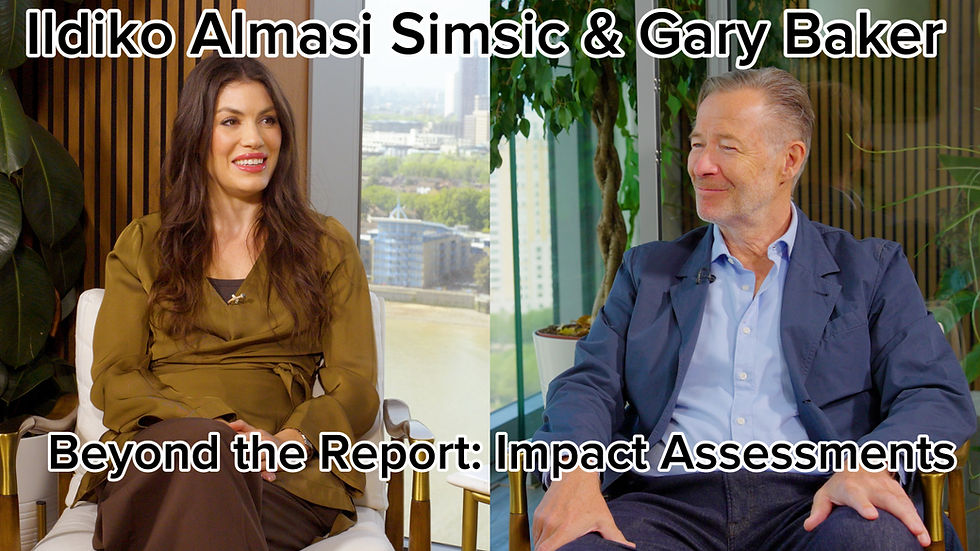
In this episode of The No Nonsense Sustainability Podcast, host Ildiko Almasi Simsic welcomes Peter Nelson, Team Lead for SEA2050 and Planning Green Futures International. They explore the complexities of national-scale Strategic Environmental Assessments (SEA) and their potential impact on future planning.
The discussion delves into the intricacies of SEAs, examining their role in analyzing policies, plans, and programs for environmental, social, and economic impacts. Peter shares insights from his experiences in Kenya and Sierra Leone, highlighting the importance of community engagement and the challenges of inter-ministerial coordination.
The conversation reveals the potential of AI tools in enhancing strategic planning and the importance of integrating local voices into national planning. The episode underscores the need for a holistic approach to future planning that considers population dynamics, economic development, and environmental sustainability.
Highlights
Peter Nelson discusses the evolution of Strategic Environmental Assessments (SEAs).
SEAs analyze policies for environmental, social, and economic impacts.
Community engagement is crucial in strategic planning, as shown in Kenya.
AI tools can enhance strategic planning by modeling future scenarios.
Population dynamics are a key factor in planning for 2050.
Local voices are essential in shaping national planning strategies.
The episode highlights the challenges of inter-ministerial coordination.
Key takeaways
1. Strategic Environmental Assessments provide a framework for analyzing broad policies and their impacts.
2. Community involvement is vital in creating effective and sustainable strategic plans.
3. AI can significantly aid in scenario modeling and future planning.
4. Understanding population dynamics is crucial for long-term national planning.
5. Effective coordination between government ministries is necessary for successful implementation.
6. Local perspectives should guide national planning to ensure relevance and effectiveness.
Timestamped breakdown
[0:09] — Introduction to the Podcast: Host Ildiko Almasi Simsic introduces the podcast and its focus on real sustainability issues.
[0:52] — Guest Introduction: Peter Nelson is introduced as an expert in strategic environmental assessments.
[1:33] — Understanding Strategic Environmental Assessments: Peter explains what strategic environmental assessments are and their purpose.
[3:23] — Challenges of SEAs: Discussion on whether SEAs are just paperwork or if they can make a real difference.
[4:06] — Case Study: Kenya: Peter shares a successful example of strategic assessment in Kenya's Tana Delta.
[6:57] — Global Initiatives vs. SEAs: Comparison between global initiatives like SDGs and the role of SEAs.
[8:25] — SEA2050 Project in Sierra Leone: Discussion on the SEA2050 project and its focus on scenario modeling for 2050.
[12:35] — AI in Strategic Planning: Exploration of how AI tools are used in strategic planning and scenario modeling.
[18:12] — Community Engagement Challenges: Challenges in engaging communities and ensuring genuine consultation.
[29:34] — Funding and Implementation: Discussion on the challenges of funding and implementing strategic plans.
[40:29] — Political Dimensions of SEAs: Exploration of the political aspects involved in strategic environmental assessments.
[42:58] — Conclusion and Future Steps: Closing remarks on the future of SEA2050 and the importance of local involvement.
Edited transcript
Hi everyone, welcome back to the non nonsense sustainability podcast. I'm Ildiko Almasi Simsic. This show isn't about saving the planet with corporate slogans or glossy brochures. Here we talk about real communities, real infrastructure, and the future we're actually building with the people shaping it and the critics testing it. No fluff, just real talk. When we talk about sustainability and impact assessment, we often think of a single corporation or a single isolated project. But what happens when we're trying to look at the full scale of global issues? How do countries plan for their future? Joining me today is Peter Nelson, the author of Planning for a Better, Greater Future, an environmental expert, community developer who spent decades working in developing countries in Africa, building about strategic assessment for country level planning. Welcome to the show, Peter.
Thank you very much, Olga. Very happy to be with you again.
It's been a long time, about five months since we were together in Sierra Leone. Um but of course constant phone calls and WhatsApp and the rest.
Yes. So in Quebec you did the buzzword battle and you explained planning for a country level future, planning for a greener future. This time since we're talking about SEA 2050, why don't you explain to us what a strategic environmental assessment is? Bob is watching. 60 seconds.
Exactly. Okay. Well, strategic environmental assessment is a process. It's a process which is designed to analyze policies, plans and programs to look at what their likely effects are on the environment but critically not only the environment also on the social impacts on the economic impacts of those policies, plans and programs. So whereas environmental assessment EIA focuses on an individual project, the concept behind strategic environmental assessment is it covers a very much broader suite of policies, plans and programs promoted by government or promoted by international organizations and companies.
Okay, well done for not getting buzzed. But the question remains, is this just a document? Is this another piece of paper or what can these assessments actually deliver?
Well, it's fascinating to see how it has developed over a period of 50 to 60 years. Initially, it started with the idea that you could simply look at a group of projects rather than just one project and you could see what the cumulative effect would be. Strategic assessment has been adopted now in up to I think almost 50 60 countries. It may be more than that. uh as a legal framework. And so for example, the European Union introduced strategic environmental assessment for every plan that's being made at a district level or a county level, provincial level, even a national level. And uh the danger is that that sort of process can just become routine. It's something you have to do before you publish your plan. And the question is, is the content of that strategic assessment going to make any fundamental difference? And historically, planners used to argue, well, we do all this anyway, so why do we need
Yes. Exactly. Exactly. So, how is this process different than the other process?
I give a specific example. Um, one of the most successful strategic assessments I've been lucky enough to work on was promoted by Nature Kenya. uh supported by the Kenyan government involving uh two different county regions and it was designed to look at a whole range of conflicts that were taking place. Those conflicts involved uh interessine warfare between different ethnic groups. It involved land grabbing from international organizations taking over large areas of what is actually an internationally important wetland, the Tana Delta. It had everything inside it. And what was different about the strategic assessment was it was paralleling the land use plan process. And so it was actually the combination of the two things which has fundamentally made a difference. That region as I mentioned uh had seen 86 deaths from uh local hostilities. It's been completely peaceful since the work was completed 15 years ago.
But is it the stakeholder engagement? Is it bringing communities together? Like what makes this plan special? So in the case of the Tanner example, 110 individual villages scattered across uh a large delta. The first step was actually to bring leaders from those groups and very carefully chosen so that it was not simply the men but also the women. Not an easy thing to do in an area where male dominance means that if you want to have a public meeting, you can only talk to men. I've got a fascinating story about it. I don't think we've got time to go into every one of my stories, but I had a female interpreter because we were talking in Kiswahili and I don't know enough Kisuahili to cope. The chief said, "I'm sorry, that woman has to go." And I said, "Well, if she goes, my voice goes."
Yeah.
She goes, "We stand there and we have no means of communication. I made the decision. I'll go with her. And I went over and joined the women under the trees who were set at a distance. They were not allowed to be in the discussion. Of course, I created a major local range of issues by doing that. An outsider, a European walking into a community and sitting down with them. It had never been heard of before. So, doing strategic assessment can have all sorts of unexpected elements to it. But the critical problem here is if you're dealing with a region or a country and there are a minimum of 5 million people living in that area, how do you genuinely consult? And that's something I know we're going to talk about.
Yeah, exactly. And then while we're at it, there are so many global level initiatives with the UN global goals, you know, they were like the Millennium Development Goals, the SDGs, other global initiatives. How are they different from a strategic assessment and why are they not sufficient?
Well, I think the challenge is that the goals themselves are incredibly ambitious. So, I just think of goal 11, which is to make all cities safe and sustainable by 2030. We have four years.
We're a bit far from that, right?
We're a long, long way. And when you think that a third of the world's poorest people live in city slums, the question is how on earth are we going to achieve it? So I look at this issue um in terms of what we need to do internationally. Total supporter of the United Nations of all its organizations. I just wish we were empowering it. We were giving it the resources it needs. But actually trying to solve these problems from the top down is not going to succeed. Which is why we're trying to develop and I'm including you in this because you're as much as it as I am. We're trying to find a way in which we can genuinely get to the local communities themselves in a country and find a way of taking their voice and building that into future planning. This is a completely I think it's a revolutionary approach.
Yeah. Uh and that brings us to SCA 2050 uh the project we're working on together where we're doing a strategic environmental assessment in the country of Sierra Leon to look at scenario modeling for the year 2050. Can you maybe talk about why 2050?
Yeah. uh the reason is that uh one of the things that I believe is largely neglected in all of these processes is the effect of population change, population dynamics. It's not necessarily about growth, although this is crucial in Africa, but it's the fact in some parts of the world the population is going down. People are becoming older. There are fewer people to work. This is a crucial problem for the former industrialized countries. In other parts of the world, the population is rising rapidly. And the area where it's rising fastest is in Africa. We're going to see 2 billion more people on this planet, 9 million currently, up to 11 billion by 2050. Beyond that, the predictions are far less certain. We know we're going to see an escalation in those 24 years. after that population could naturally start to decline. It still could increase. So 2050 is a turning point and there are so many turning points uh when we talk about climate change, biodiversity loss, all of the issues that are fundamental to the future of humanity and the planet.
For me, uh it's actually not adequate to look at any one of those issues, which is what the international community does. Somebody is focusing on health. Somebody is focusing on biodiversity. Somebody is focusing on energy. But we never bring these together. So the great concept that you and I are working on is this idea that if we could reach the young people and that's a debate.
Who is a young person?
Maybe for the listeners, we had this debate because Peter's original idea was that everyone under 30 counts as a young person. But then some of us over 30 thought that we're still young. So we have actually increased this age limit up to 40.
And some of us would like to take it up to 80 as well. But it's it's all a question of whether you're young at heart. And so what we're trying to do is to get people who are fundamentally going to be the nation's leaders in 2015. They are going to be people in their 20s and 30s now who will be the leaders. And we're saying to them, this is your opportunity to tell us how you want to live in 2050. How do you want your children to live? And we started our exercise, as you remember, by simply uh teasing people. We said, "Here are 18 different things that you could wish for in your life. Do you want a car? Not in Sierra Leone. Not a child. Do you want a comfortable house? Do you want safe water? Do you want enough food? Do you want some medical advice for your par? What do you want? You can only choose one. And our idea was that we could draw out different opinions from different parts of the country. Have to say that hasn't totally worked for a number of reasons.
Why Sierra Leon? So we started the initiative in Sierra Leone. Why was this country selected to be the first in this pilot?
To be honest, it's because I know that country best. I started working there in 2009. But it's also because I know as a country uh the people have enormous potential and I'm asking myself constantly why is that potential not realized and for me Sierra Leone as the sixth poorest nation on the planet and I heard yesterday that this country the United Kingdom is fifth richest country in the planet. If Sierra Leone could demonstrate that it can make a plan for 2050, why not everyone else? And so my vision is actually to roll out using the example of Sierra Leone to roll out this concept of self-determination across the world.
That's very ambitious.
Very very
That's very ambitious.
But but just to show uh we're not only focusing on the poorest country. We're also looking at one of the most aspiring middle-income development areas in Africa which is Kenya population over 60 million population extraordinarily successful economically within the African context and we're busy building up for our second pilot um which in itself creates many different challenges.
Yeah. And that brings us back to our story time about how we met. Because Peter has been working with strategic environmental assessments for a while when I met him back in 2024 in Dublin, the annual conference of the International Association for Impact Assessments. And u I was just wandering through the corridors. It's an overwhelming event with so many parallel sessions, all of them amazing and inspiring. And the door was open. And so I went into your session on the Golden Breeds Initiative which was talking about strategic assessments for 2050 and I remember listening to the presentation and just the pure determination to make it happen. Your enthusiasm and dedication and and hopeful spirit that this this can happen really inspired me. So after the presentation we connected um that was also the year I launched my company uh working with AI. So I knew that some aspects of the research and the data gathering and running these like modeling could be done so much easier with the use of technology. So we got together and we started thinking about how to actually do that. But it wasn't smooth sailing. Right.
Absolutely. I I must just say the one thing that I remember from that very first introduction was when you came up and introduced yourself, you didn't do it in the way that normally happens with I'm in this company or I'm doing this that or the other. What you said was I like what you're saying for my daughter and that was that was the telling point for me because that's what it's about. It's not about our generation, it's about generations to come. And uh basically when you introduced yourself and explained uh that there was this potential for artificial intelligence to play a role my first reaction was skeptical and for the same reason we could have a whole debate couldn't we about where we stand with AI.
Yeah. But that's what makes this partnership so interesting. Absolutely. because I come up with my ideas and you challenge them and sometimes you know your your skeptical point of view is the one that we're we're choosing to go down on but sometimes you know you see the benefit of technology so I I really appreciate these challenges because I I am a technology optimist so it's good to get that feedback
but I remember in fact from the one of the first WhatsApp uh we'll talk more I'm sure about the social issues But in the first communications with some of the people in Sierra, the first questions are, are you in the pay of government? Are you uh simply absorbing our information? And there is enormous distrust in undeveloped parts of Africa with almost anything that represents modern technology, critically things like vaccines. Um people I I only I was in Sierra Leone last week in the course of listening to a pastor who was preaching to his congregation. He was saying, you know, do not take vaccines. They are an invention of the west. And this is to a group of 20 women, all of whom have two or three children with them. And I'm thinking if those kids are not going to be vaccinated as a result of one not well, I can't say it was not carefully thought out. It's a very strong view amongst some sectors of the community
and and that is fair. And I I was actually happy that there was this like skepticism and that they asked the right questions uh because we do treat the data according to GDPR. So whether that comes through the WhatsApp channels, the emails um you know we safeguard it for them. And that just leads us to the other big question on implementation challenges because it's one thing that we come up with our ideas how we're going to collect the data how AI is going to run the scenario modeling and we have machine learning and deep learning algorithms and it's like all amazing but it has to be translated in a way that the locals understand what we're doing and we also have to build trust. So technology is just one part of this whole process but the most important part is this uh direct engagement with the people. So we do have a local team um maybe as a backstory. We traveled to Sierra Leone together in January 2026. There will be a little documentary coming up of launching the program because that was the official launch. It was not smooth sailing. It was not very straightforward, but we persisted and now the program has been running for over 6 months now. We're happy to see the results that we're seeing. It is of course a slow process just because you work with government and they have a million other things to do, but we're keeping on track and we're not giving up. Right.
You've introduced two or three different ideas in the middle of that. And the first one I think is just to come back to that issue of how do you engage with people.
Yeah.
And so uh when I mentioned earlier most strategic assessments are involving large areas 5 million people plus. Is it really realistic to talk about engagement at that level? What normally happens is that the work is done within government. It's done with a group of consultants. uh you have so-called focus groups who come in and give a view on behalf of different parts of uh society but in reality there is very little option for true consultation. So number one in our program what we have done as you rightly say is involve Tamba and Ranita and Muhammad and Chris all ceremonians who are dedicated to our process who are reaching out through social media things that I have very little knowledge about Tik Tok. I'm I'm apparently I'm now an influencer. I'm very happy to be an influencer whatever it is if it promotes our project. So X Tik Tok and all.
Yeah. But we we recognize that if we want to talk to the young people, we need to find the channels that they watch and that does not discount your idea of going through the formal TV channels which is something you've done before on strategic assessments. Right.
Exactly. Exactly. So you know this for us is a learning process never mind anybody else. So we're reaching out and in fact the latest development there is to set up uh a coordinator in each of the 16 districts across the country. Uh so each area has something like a million two million people involved but from that group we are finding 10 individuals who are willing to dedicate themselves to this process. So we will be sounding out to about 150 people on a regular basis. We'll be putting out all of our messages. So crucial thing I wanted to stress is that this is a genuine attempt to reach out. The second part of what you were raising is what I now appreciate is one of the most exciting parts of what we're doing because we can see artificial intelligence just advancing at an phenomenal rate and so many questions are about where it will have ne negative impacts loss of jobs or whatever. I have that debate with my wife all the time. She says what you're doing is simply removing jobs from people. No, I don't think so. I think we are creating an entirely new way of engaging and discussing. So what I'm convinced by and I've yet to see the product cuz that's your end of the exercise is that this idea that we can take what we know about the country today. We can look at the pressures on it, the the the opportunities for development and we can model endless scenarios about how things might develop to 2050. What are the potential pitfalls? Uh what are the big opportunities for investment? And we're going to do that in a way that we can share with our our I'm going to use he's going to beep at me our stakeholders, our community because that's how we're trying to engage everybody.
Yeah. So maybe a little background on the AI tools that we use here. Uh my company developed this close AI which is a chatbot where we set up we created the library of information that we share with the people and we trained a model on creo and antenna. to the local languages. We introduce speechto text, text text to speech features. So they can ask any sort of questions about the process only that is the strategic environmental assessment uh ca 2050 and also provide feedback through that channel. We also included an email address for general feedback communication and the social media team has used several AI tools to generate images or like edit images that we use to share information about the process. Obviously the first stage was the scoping stage where we had a draft scoping report. There it is. Uh that was uh shared for consultation. Various like snippets and findings of this report were incorporated into the social media content strategy and in addition we were scraping comments on yes we were we were collecting comments from our social media uh platforms from people to do a sentiment analysis. um we used AI machine learning algorithms because it was a large number of feedback. In addition, we also had the WhatsApp channel where people often left voice notes. So that was one of the reasons why we decided to train the model on the local language because it did not recognize you know that was in 2024 there were efforts to sort of like include the south in like AI. So there are pre-trained models on Creo but those are more the text to text not text to speech or speech to text. So we gathered material we used some of our local team to send us voice notes so we could fine-tune this product and that helped us transcribe and translate messages from the people. But the most interesting part for me uh about the AI stuff is this agentic AI government planning tool that basically absorbed all these data from publicly available sources um you know national statistical office covering many many sectors from like mining, agriculture, healthcare, tourism, environmental degradation, flood risk, water management, energy you know it It took us a lot of brain power to to think about everything so that we don't miss out. Uh we set up these data sets and then we used open-source uh deep learning and machine learning algorithms. We fine-tuned some we had to build some because as you were saying these topics are complex.
I love the way you've managed to explain that with only one buzz. uh because when Ilico first started talking to me uh I really struggled with some of the the definitions and the process that's involved. Um but I want to give a a practical example because this is the way that I try to explain it when we're actually face to face in the communities and that is the fact that Sierra Leone currently has 9 million population and the reason we talked about 2050 is because it will grow to 15 million. It's a 60% increase. It's another 6 million mouths to feed, another 6 million children who will have to enter schooling in that time and the education standards virtually all of the parameters that in the western world we would just accept as norms don't exist. So if you talk about how many schools are going to be needed for six million children
and where
and where and then who's going to pay for them but then critically who's going to teach in them where will you do the training and it doesn't matter whether you talk about education or you talk about the health service uh it's quite staggering for me that Sierra Leone has under 400 doctors for a population of 9 million when we were in Quebec. I did the statistics on Quebec.
Yeah, remember
in Quebec they have 26,000 doctors and it's still top of their local news that you can't see a doctor when you want to see them in 24 hours. In Sierra Leone, you can't see a doctor period unless you are in a major city.
Yeah, exactly.
So, so these are the things that your algorithms this this whole process will help us to build. We'll know how many schools we need. We'll know how many hospitals. We'll know where. We'll know how much it will cost. And we will be able to develop realistic programs for what needs to be done over 20 years. We're then going to be able to take that. You can see I'm getting we can take that information to government. Uh it will assist governments who tend to work on a five-year program.
Yeah.
And only government is in office for maybe four or five years. we talk about a 10-year program but the idea of actually planning ahead for 20 years is there there are there are instances but it's not common
and and also the other uh advantage of having technologies that were moving from a static report because previously you did an strategic assessment and that was it. You planned for 5 10 years 20 years and yeah maybe that was an update mechanism but it wasn't easy or fast at all. Now we have the especially for the the topics where we have a lot of data where we could fit it on a deep learning algorithm. If you add the new data, you don't have to retrain the model. it just in absorbs it and does the scenario modeling updates it um almost every year or whenever something major happens like if there's a earthquake or tsunami or you know like some like Ebola outbreak that changes the the structure of demographics like we can immediately update we don't have to wait for anything we see how our current plans compare to what actually is happening happening on the ground and I think you both of us having that field experience working on individual projects working with communities makes this a very pragmatic thing. We're not just saying you should have uh economic policy that creates employment. We're going to say like, okay, what kind of jobs where what what makes sense? If you're looking at the urbanization, if you're looking at demographic growth, if you're looking at the need for energy in certain parts of the country, like how how will those clusters look like in 20 25 years? I mean, I'm really excited by the thought that we will be able to introduce the work we're doing to all of the other bodies who are trying to do similar things. So, you may have uh an international aid agency who are working on something like malaria eradication um who will have specific programs running over a 5-year period. We're going to be able to share the information we've got with all of those bodies. We're going to be able to share it with international business. We'll be able to share it with the international financial agencies and say basically we've created a structure now let's see how we are going to actually develop this and it's actually one of the interesting questions that came from our WhatsApp. People are saying to us look you're talking about 25 years of development but we're worried about where we're getting food on our table tomorrow.
Yeah. we have no jobs. Where are we going to find the jobs? So, what I'm rather hoping is that when we built our our model and we've got our scenarios for 24 years, we can track it year by year. And this brings us to the crucial question. I'm probably breaking away from our theme. We're running all over the shop, but I think that's fair. It brings us to this question of where will the funding come from to support the sort of initiatives that we're running
and where will the funds come from for the different elements because it's one thing to do the process and have this like you know whatever cloud-based uh live dynamic strategic assessment for the government but it's the other thing to actually implement the projects that are recommended or the policies that are recommended and I know we've struggled a lot with the coordination around different government agencies. This is not unique to Sierra Leon.
No,
I know even the UK government set up this uh NISTA to try and coordinate work across departments and set up project pipelines. So instead of overlaps and inefficiencies there the work is more coordinated. So that's exactly what we would be trying to do in Sierra Leon. I'm very struck by the fact because we've just done an exercise of visiting a number of ministries and we have three ministries that are supporting what we're doing in principle in including the chief minister the honorable David Sangi who gave us a 15-minute audience and then gave us the thumbs up um and we're working with uh the honorable Chernab who's the minister for information uh Selma Bar who is the minister for innovation and the uh minister in charge of environment and climate change and we're in the process of course as you know we're setting up this service level agreement but as you rightly say when you go and knock on the door when you go to any particular office doesn't matter what organization whoever you meet is focused on the day job and this idea that you can explore things for the future it's it's not easy to find within government the appropriate place to to enter into the exercise. But the point I wanted to develop, I may have said it already, is this idea that with your uh forward um planning through scenarios, we could actually track on an annual basis everything that we have predicted for the future.
Yeah.
So we can always bring the process back on course if something like Ebola or hopefully this will never happen again. Zero. And I just put a plug in for that country. Uh this country, the United Kingdom, where we're sitting today, was very very slow to react to the Corona virus. And we've had an public inquiry running for at least two or three years now trying to investigate why things didn't happen. What happens in Sierra Leone is people learn fast. Not only during Ebola did they have superb monitoring in the country. You were there. I was in the country through Ebola and I remember traveling at the height of the rains uh from the north back down to Freetown. At that stage there were curfews, there were embargos on travel. It was absolutely thundering and raining for days on end. And as we drove along the road, we were stopped at 5 mile intervals with a single piece of rope across the road. And at that checkpoint was a soldier, a policeman, and a nurse. and they insisted we got out of the vehicle. We had our temperatures checked. We had our destination. The vehicle was inspected and on we went it. It's quite astounding how efficient Sierra Leone can be, which is why I have great confidence in the future.
Yeah, I guess we'll see.
We'll see.
Yeah. So in a way the idea of this cross departmental coordination and creating a market kind of came from my work with the IFC where they have tools such as upstream where they're going into countries helping governments to create markets and that is part of our idea for this sea 2050 with the technology and especially when we look at it as like a broader government planning tool. So when you identify the the investment needs of the country, which sectors to prioritize, what projects could be done there, we can go very very practical. How long it takes to build the hospitals, how long it takes to train those doctors, how many we actually need and where. So the idea is that we would be creating this market for all sorts of investors whether they're development finance or private sector or NOS's to just come in and you know pick a project they like and sort of contribute to this centralized pipeline of investments or projects right
absolutely uh one of the things which is quite fascinating I I guess why we both do what we're doing is this idea that we're pushing the boundaries. We're testing ideas. And what I've begun to realize is yes, what we're doing is highly complex, but okay, we talk about 6 million additional places at school. We calculate how many schools we need. We work out how many teachers. This is not, dare I say it, rocket science. But the issue is who's going to pay for it. And this is now coming into the my focus all the time because if we look at some parts of the world, they've always been the provider. They've always been the source of raw materials whether it's minerals or timber. Uh basically those countries are providing the iron ore. They're providing the timber box, but the processing takes place elsewhere in the world. the entire value and the value chain is somewhere else and so serrialeone has been supporting other parts of the world now for over 200 300 years and the question and and that's still continuing so they are major producer of iron ore of borite of rare earths so many different minerals where the basic money paid to the communities is peanuts the question is how do we develop an economy that will be self- sustaining in future and I'm getting increasingly interested in that whole idea of a circular economy
economics this idea that we can actually support the financial sector in Sierra Leone which means talking with the banks talking with and and there are real genuine entrepreneurs within the country and I give a specific example before its civil war was a major source of cocoa all of that disappeared because the cocoa farms were no longer managed. But out in the jungle, cocoa trees exist. And I met an American investor. He was actually Sierra Leonean coming back to his country saying, "I'm going to recover those cocoa trees and I'm buying them from the community." Now, that's still somebody from outside planning to exploit. Um, as I came back through the airport 3 days ago, I saw for the first time a product. It's actually coffee from Sierra Leone. Another interesting story here, Q Gardens has sent a team to Sierra Leone because it's been identified as one of the few places where there are still indigenous coffee cocoa beans. So basically I think we've got to explore who are the potential investors, who are the people who genuinely want to support the country as well as develop their business as well as make profits. So my argument would be it's a win-win for everybody and I think that will come out of our strategic assessment. What makes us different is we're not just reviewing somebody else's policies, plans and programs. We're helping them to build better policies, plans, programs,
but without enforcing our world view on what's the best way to do that. So
because, you know, I think we're both very cautious about that. We have some ideas. We've seen things in different parts of the world, but we're not forcing it on the people. This is an initiative led by the people. So if they tell us to prioritize certain industries or sectors then that's what we're doing and we rely very heavily on our local team and all the implementation going forward. So now we're uh consulting on the scoping report. So we're in this like stage where we set up these u district level coordinators to discuss the scoping report to help finalize it. uh we're finishing some of our um scenario modeling so we can also disclose that and consult on that but ultimately we're just there to help the people take charge of their own future.
You raise a very interesting point because it's accepted within our field the the area we work in that a strategic environmental assessment uh does not make any decision. it passes the findings to a decision maker and that is absolutely true and it's what I believe in. But I also think that strategic environmental assessment or those of us who work in the field can't deny the fact that how an individual a project manager approaches the job does color the output. And you're quite right to bring me back to that point that it is actually Sierra Leoneans who will decide the content. But from those comments I'm making, for example, about the the economic issues, I'm clearly inputting my views on that. I know they're well shared amongst the people in the country that I'm working with. Um, but that's inevitable. You know, it's it's a two-way process. So the strategic environment assessment for me is not is not a sort of just routinely mechanical exercise of looking at somebody's plan or a program and saying this this this this. It's actually helping to generate something for the future.
Yeah. Exactly.
And then it it comes back to you know some of the questions we received especially from the young people during the consultation at the university.
Is this a political process? I think the answer to that is in one sense yes. I you'd be surprised for me to say that because I've been saying all the way through it's exactly
it's not critical and the reason I say it is that it's almost inevitable that some of the commentary that will come back will be critical of government or supportive depending I'm reminded that I had a discussion with one minister who said what can your sea deliver in the next two years because we have an election coming so that gave me a very clear indication that for that minister this had a political dimension what I've argued as you know is that we're dealing with period of it was 25 when we started is 24 years there will be four administrations we simply don't know which government will be in charge um I'm just thinking the equivalent with our national politics here in the UK at the moment nobody knows what the situation will be in 12 months never Exactly. 24 years. So the reality is uh government does its job. The present government is doing a very thorough job working with its five-year development plan and it has very specific objectives like feed salone major push. It's got a major push on on youth. So inevitably we start with where the government is. But once we move beyond the five years, we get into the realms of what will happen in the future. And so it's politics with a very small P because how a country governs itself is also critical. Um we couldn't say that the United States of America, whatever plan you might make for the future, can be divorced from politics. Politics is absolutely central to the way that a country develops. So at the end of the day, we will have to include governance as one of the themes that we have to explore. Um I could say that Sierra Leone has a two-party state. I mean it government moves um between the two main main parties. There are other parties formed but they they're up to date in the 30 40 years since independence more than that 60 years that there hasn't been a dominance from one side or the other. So politics is part of it but we are not in any way trying to influence politics.
Well thank you Peter for being here with me today. We will link the website keep an eye on it. We'll be updating the dashboards. You will see the output of our assessment and the scoping report, the feedback from the people and also we will be launching the documentary at some point. It will be a fantastic recap of our trip to Sierra Leone and all the uncertainties and challenges that brought us today here in the studio. As you see, we're only halfway through the process. There's a long way to go and I'm excited to see where it takes us. Thank you for being here with us today. If you like this episode, share it with someone who should be finding out more about strategic assessments. I'll see you next time.


Comments