


Understanding Health Impact Assessments with Ben Cave
Watch the episode
Summary
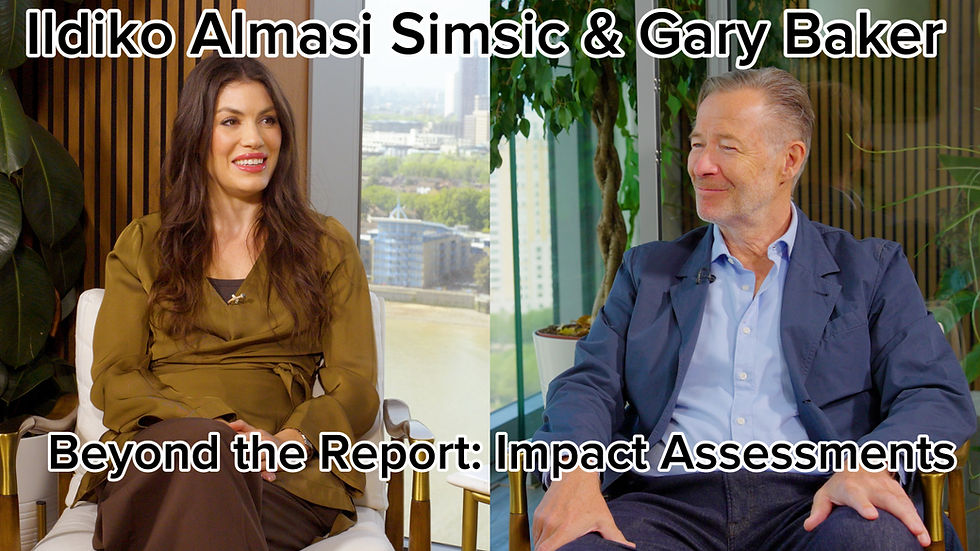
In this episode of The No-Nonsense Sustainability Podcast, host Ildiko Almasi Simsic welcomes Ben Cave, a leading expert in Health Impact Assessments (HIA). The discussion centers around what HIAs are and how they can be effectively implemented in development projects.
Ben Cave explains the determinants of health, highlighting environmental, social, and economic factors. He also delves into the importance of considering vulnerable groups in HIAs and the role of health determinants in assessing project impacts. The conversation touches on the integration of HIAs in environmental assessments and the legal requirements in different regions.
The episode concludes with insights into the collaborative process between developers and health stakeholders, emphasizing the need for dialogue and understanding. Ben also introduces the newly released Handbook of Health Impact Assessment, which serves as a comprehensive guide for practitioners and is available for free download.
Highlights
Ben Cave explains the determinants of health, including environmental, social, and economic factors.
Health Impact Assessments focus on enhancing project designs and mitigating adverse effects.
The importance of considering vulnerable groups in HIAs is emphasized.
Legal requirements for HIAs vary by region, with some countries mandating them.
Collaboration between developers and health stakeholders is crucial for effective HIAs.
The newly released Handbook of Health Impact Assessment is available for free download.
Key takeaways
1. Health Impact Assessments evaluate how projects affect health beyond healthcare systems.
2. Determinants of health include environmental, social, and economic factors.
3. Vulnerable groups experience health impacts differently, requiring careful assessment.
4. Legal requirements for HIAs differ globally, influencing how assessments are conducted.
Timestamped breakdown
[0:23] — Introduction to the Podcast: Host Ildiko Almasi Simsic introduces the podcast and its focus on real sustainability issues.
[0:46] — Guest Introduction: Ben Cave is introduced as an expert in Health Impact Assessments.
[1:29] — Determinants of Health: Ben explains the various factors that determine health, such as environmental and social factors.
[3:55] — Vulnerable Groups: Discussion on how different groups are affected differently by health impacts.
[5:39] — Scope of Health Impact Assessments: Exploration of what is included in a Health Impact Assessment.
[10:37] — Legal Requirements for HIAs: Discussion on the legal requirements for Health Impact Assessments in different regions.
[13:45] — Becoming a Health Impact Expert: Ben shares his journey and the skills needed to become a health impact expert.
[23:42] — The Handbook of Health Impact Assessment: Introduction to the newly released handbook co-edited by Ben Cave.
Edited transcript
[music] [music] Hi there. Welcome to the No-Nonsense Sustainability podcast. I'm Ildiko Amashe Simsek. This show isn't about saving the planet with glossy brochures and corporate slogans. We leave the PR spin at the door. We're here to talk about real infrastructure, real communities, and how we're actually building a future. With the people shaping that future and also the critics testing it. No fluff, just real talk. Joining me today is Ben Cave, the powerhouse in health impact assessment and the past president of the International Association for Impact Assessment. Most recently, he co-edited the Handbook of Health Impact Assessment with Francesca Viliani and Mirko Winkler. Today, we're here to find out what a health impact assessment is and how to do it well. Welcome to the show, Ben.
Hi there. Pleasure to be here. You are familiar with Bob because I know you did the buzzer battle to explain what a health impact assessment is. So, today we're moving away from that and I will ask you to explain either what you mean by vulnerable groups from a health impact perspective or what are the determinants of health. Which one do you pick?
Well, I'm going to you've got I've got 60 seconds to define them, have I? I think.
Yes. Yes.
Okay. Well, I'll give it a go for both in 60 seconds. So, health determinants are things that affect or determine our health. They can be environmental, so think air quality or noise. They can be social. Do you have a home? Is the quality of the housing fit for purpose or is it hot? Is it cold? Damp? Poorly ventilated? All of which can be damaging to health. Determinants of health can be economic as well. Do you have a job? Is your job well-paid? What are the terms of the employment contract? I think a main point to take away is that health and what creates it, our health, the health of our family and of our neighborhood is determined by factors that are outside of the health system. So, doctors and nurses and health care professionals are essential, but they're not the whole story. It's what's happening across society that's important. And just to put this to give us statistics to this, in 2019, the World Health Organization said that 23% of all deaths globally, that's almost one in four, can be prevented through healthier environments. And the one in eight deaths are attributable to air pollution.
Okay. That was my 60 seconds, but I'm going to beg to go on for a little bit more. I just want to add that the term health determinants is used in health impact assessment, typically during scoping and assessment, mainly. And the number and range of health determinants continues to grow as science tells us more about or reveals more about the links between society and human health. A final point if from an assessment standpoint is that this term appears in the International Finance Corporation guidance for health impact assessment, which actually names social determinants of health as one of the 12 environmental health areas. So, they take a slightly different way of approaching the health topic, but health determinants is very much there as well. And Hildegard, while I've got the microphone, I'm going to just speak a bit more because I want to talk about vulnerable groups as these also are very important and as sort of intimately linked with health determinants. So, if we think, you know, within any one household, any neighborhood one neighborhood, we all experience things differently. Some people are more vulnerable than others. This might be due to wealth or poverty. It might be due to where you live, your age, are you young or you old? Your gender, etc. So, two statistics to illustrate this are that people with disabilities have double the mortality rates of those without disabilities. Quite staggering. And if we're looking at people living within fragile settings, the risk of a woman dying from pregnancy in a fragile setting is massively higher than in non-fragile settings in societies where there are not huge amounts of challenges and interconnected problems. So, if we're looking at an impact assessment or a management plan, it can we cannot assume that everyone is affected in the same way. The effects health included from the influx of a new population will differ across the community, for example.
Okay. Now, that was a very very clear description. I know that in our ENS world and when we're developing these big projects, we come across community health and safety or the health of communities, but that is different than a health impact assessment, right? What is in the scope for a health impact assessment? What are the key things you're looking at?
It is in some ways an HIA can be quite broad. They take the definition of health as given in the WHO constitution of being more.
What is that definition? What is that definition of health?
The full definition is I'm going to just read here so I don't get it totally wrong. Health is a state of complete physical, mental, and social well-being and not merely the absence of disease or infirmity. So, once again, the health care professional is essential, but so is the rest of society. Health is something positive to which we all aspire. This is a really ambitious framing and puts health at the heart of human rights and the heart of everything that society does. Following on from this positive definition of health, health impact assessment looks for enhancement to the design of a project, program, plan, or policy, as well as mitigating adverse effects. So HIA looks to make things better as well as stopping bad things from happening. And just note that even though with we say health is positive and health is positive, we find it easier to measure the negative. So, we measure death, disease, and injury.
Yeah, because I kind of feel like when I think back to my own project experience, it always came with this adverse impact connotation. Like there will be dust and noise and that will affect people adversely and we need to mitigate. So, whenever they were talking about protecting community health, they, you know, put up the dust or the noise barrier. They were like putting water on the road so there's less dust. But there was no real investigation as to how the project actually impact people's health. And as you pointed out, a lot of these baseline environmental emission thresholds were kind of calibrated for a healthy grown male, but the reality of who's in the community in also includes children, elderly, women, pregnant women, people living with various disabilities or long-term illnesses. So, how do we differentiate what we put in the ESIA, for example, so the impact assessment section that we typically look at under community health, and what would be a separate health impact assessment scope? Because that determines how the developers approach the topic. So, for the permitting, they're more than happy to pay for the assessment so they can go on with their project, but very often the conversation around how their infrastructure impact health, they it gets defensive. They think they're not the Ministry of Health, they're not responsible for systemic health care issues, or people's, you know, pre-existing conditions. So, when we're looking at a project, where does the health impact expert come in?
Oh, thank you. Okay, there's a lot in that question. I'll try and take your points in order. So, to start off, mitigations that developers do, so managing construction with noise barriers or using waters to suppress dust, these are really important, and they do have protective effects on community health and on worker health. Who is in the community? Absolutely, you need to know.
Do they really want to know, though?
But if they don't, they should. You can always expect some tensions between a community and an operator, but these must be dealt with promptly. Knowing your community is a first step to knowing how to manage your construction or your operation. I accept I'm talking good practice and this but this is central to IFC guidance that places great premium on the experience of vulnerable disadvantaged groups and the remedies that should be available to them. You also asked about what's in the IA in the impact assessment and should there be a separate scope for health impact assessment? Well, as so often, you know, it depends really. The starting point is that health is addressed within the ISHA or the EIA. And there may be circumstances where a separate assessment is commissioned, but quite often it's better to keep it all within one assessment framework and one assessment team to ensure that the scope is robust and proportionate and that all assessment topics are linked.
Okay, that's good to know and that brings up the next question. Is this a legal requirement? And if yes, to what extent? Because as we know, even in the environmental permitting process, you have the national requirements, but there's often significant gaps with international standards or best practice. What's the case with the health impact assessments?
Another good question. HIA's required by legislation in some countries. Wales has just passed HIA regulations requiring public bodies to What's the wording? Public bodies must do an HIA when they propose to make a decision of a strategic nature about how to exercise its functions. There are other examples around the world, for example, in Thailand where developers are required to do HIA. But in general, environmental legislation is very important in establishing this formal requirement for human health to be considered when plans, programs, or projects are assessed. And the safeguards of the banks and international financial institutions come into this fall into this tradition, too. This inevitably affects how an assessment is conducted. Good because, you know, who answers that requirement to assess health? Which regulator signs off the assessment? The danger is that the Ministry of Health doesn't really get involved and the assessment of health is left to environmental and social specialists, both within the developers and regulators.
And I think it's also interesting to point out that often there is no requirement in the legislation to add a health expert on that environmental team. So, the expectation for the team that is preparing that environmental assessment is that they're the jack-of-all-trades, right?
Well, as impact assessment grows, the range of expertise needed to inevitably grows, too. In environmental impact assessment in the EU, there is a requirement at EU and UK, there's a requirement to show the competency of the team conducting the assessment. This is often interpreted as needing the IA experts to state their competence. The health group at IEMA developed some competency standards.
Can you spell out the abbreviation?
Yeah, yeah, fair point. IEMA now changed its name. It's now known as ISET, which stands for the Institute of Sustainability and Environmental Professionals. And they developed this competency standard for those who do health in environmental assessment and those who do health impact assessment. And they're the same. They treat these two groups as one. So, the skills and the capabilities are the same whether health is assessed as a standalone assessment or with a broader environmental assessment.
Yeah, and that's interesting to bring up the, you know, the skills and the capabilities. What makes someone a health impact expert? Are you all doctors or have medical backgrounds? Or how do you end up as a health impact professional?
Mhm. Yeah, well, I'll answer this from a personal point of view, if you don't mind. So, my academic starting point was social anthropology, and then I studied public health. I was looking for ways to apply the learning from anthropology, and I'd always been fascinated by the ways that health and community overlap and there's this centrality of society and culture to the ways in which to the health of people and of communities. I then became interested in impact assessment as it was a way to be improving and protecting health and to take this outside the health system. And to work with communities, planners, engineers, developers, etc. So, you know, the competency standards don't require a medical degree, but they do require training in or knowledge of public health. You know, come back to the point you made earlier. Doctors are linchpins, and they bring the gravitas and authority of the medical profession. So, they're important people, but HIAs are specialists within public health, and that does not require clinical training. Public health, as its name suggests, looks not at individuals, but at communities and at populations, which is a perfect fit for impact assessment.
No, it's always good to know, because as you pointed out, you're trying to be part of this team that develops these broader impact assessments for different projects and developers. Yet, the outcomes of your impact assessment might not be something that the companies are very happy to take on board.
Yeah, yeah, can I just add one point more? Another key specialty is occupational health, which deals with the health of the workforce, be they be that during construction or operation, and we mustn't forget them. But, I'd say public health is a is your sort of go-to overarching specialty for certainly for the assessment phase.
Yeah, I kind of feel like that occupational health and safety, you know, if you're looking at it from a stick and carrot perspective, that's legally required. They can get fines, they can like revoke permits, and stop production or construction if they don't comply. So, I think that's kind of like an easier sell in in all of this. So, you mentioned that you're trying to be part of this like broader impact assessment team, and incorporate the health impact aspects into the impact assessment as such. So, what happens when your findings are not favorable to the developer? What happens when you find that there's pre-existing conditions, additional sources of pollution, and yet because you are the one who found those impacts in relation to this project or this developer, it's almost an unspoken expectation that they're the ones addressing that. In your work with developers and operators, what are the typical sensitive discussion points around who pays for it, and what do we do with the findings?
That's a really good question. But with respect, the way you've framed it makes it sound like it's a big surprise to the developer. And I think quite often all parties are aware that something is not right, or they've got a solution, but they haven't got around to working it through. And once you start talking, the discussion then becomes around the scale of the issue, where responsibility lies, and what can be done. So, by way of illustration, I worked on a large energy project in Wales. And this was going to bring a large construction workforce to a rural area. And there was concern amongst government and communities about the effects on traffic, on house prices, on tourism, so our central local economy, etc., etc. A whole range of concerns. And the health stakeholders, for their from their perspective, they were clear that if the health care needs of this workforce were not met, then there would be major effects on the local and regional health systems. And with really serious adverse effects for residents. The initial position of the developer was that, you know, they were aware of this problem and that it was something that was going to be dealt with. It would be mitigated by a dedicated service for the workforce. And that there would be a site allocated directly adjacent to the construction site for health care provision. And so it could deal with incidents on site as well as other wider workforce issues. And this kind of approach is what they'd taken on other construction sites elsewhere in the world. I but crucially not in Wales. And so the health stakeholders were asking for examples and you know, how has this worked and how did it work and what went wrong, etc., etc. What went right as well. They wanted particularly more information about what would be offered and how it would tie in the with the services they were offering, too. What would happen when workers went to a local provider rather than to the construction site because the local provider wouldn't be able to turn them away or wouldn't want to turn them away. So there would be inevitably some some overlap there. What about the families of the workers? Some workers might You know, they were saying that you're going to It's not all going to be single men. You'll have people coming with families, with dependents. And so where will they get their health care from? The health stakeholders knew their patch and they knew the challenges of developing a service and integrating it in with existing services. So detailed discussions began about general principles of setting up a health service for the construction workforce, where the health care staff would come from because this also was a challenge there, you know, recruitment and retention. How you would set up this service that meshes with and complements local services. And this included also beginning to work on and sketch out an indicative budget. So there was some trust began to be established on each side. And the really a key turning point was when the developer began to share more of their thinking and it became a dialogue with local health care providers. And this also meant each side was able to begin to plan and to see the benefits that could accrue from this. So it went from being yes, we have a technical fix to that problem, don't worry about it, to yes, we will do this X, Y, and Z. And then thus the local service providers were were able to sort of start planning and preparing and kind of seeing how this could be tied into the wider system. So the talk turned it you know, to training and legacy and opportunities rather than kind of some vague offering of a bolt-on sort of a fixed bolt-on which would be be less than optimal, put it that way.
And was it challenging to set up that relationship with the health care providers because they're not necessarily amongst the stakeholders or the main stakeholders when you're like mapping out a project?
Well, well, this and again, coming back to your question earlier about scope, this kind of popped into my mind. We because this was in Wales and Wales has a particular history and tradition of health impact assessment. So, we were actually had been commissioned to do a standalone health impact assessment there, but I'll right from the start we was we said we are going to work hand in glove with the environmental impact assessment team. So, so we were in all to to all effects kind of integrated with them, but I think because we were a dedicated health team from the start, we we had the support of the local health system and they wanted to talk with us. And again, you know, Wales is a high-income country. The there is a a well-functioning health system there and they were able and willing to take the time to to talk with us. And because there's a tradition of HIA in Wales, this was you know, signed off. It was institutionally validated that the health stakeholders would spend time talking with us because they could see the value of that coming down the line.
Yeah, I think that was definitely a lucky situation where the legislation and the stars aligned.
It is it No, I agree. And so, that shows the importance of that. I mean, what almost what felt like more difficult was it was like we were pushing on an open door but first first with the client because again, they have a clear idea of what would happen. And in the previous ways in which they develop projects, they hadn't engaged with the health stakeholders in this way. So, so sort of programming things out in their head, this was something for much further down the line. And again, you know, it was a process of talking through with them of no, you you it was sensitizing them almost to the importance of this. So, as you say, that's that's probably a case that stands out on its own, but but it also shows that it's you know, it shows the importance of the dialogue, however you're doing it, and it is a dialogue.
Yeah. Now, let's talk about the handbook. Like, I cannot wait to find out what's in it. So, as I understand, the three of you with Francesca Mirko co-edited it. How is it different from the previous one? What are the key key highlights from the book that you would want to share with the listeners?
Ooh. Good question. Well, first of all, here it is. There's the handbook. Hey. And it's available to buy in all good bookshops, but it's also totally available for free as a download. So, you can there are 29 chapters there, and anybody who's got access to a computer or a mobile device can download each and all of the chapters. Okay, key lessons for health impact assessment. Well, let's think. Health impact assessment has been used for over 30 years. It's a key public health offer in terms of what public health can provide, but also towards sustainable development. Health impact assessment is used by government, by industry, by communities, and by civil society. It could be used more. The handbook we are delighted with. It presents the writings of over 90 authors from across the world. So lots of wisdom and reflection there. It's available to buy. It's also available open access. So 100% free, totally available to download. So we hope that people find it useful and let us know what you think. Okay, thank you very much.
Thank you, Ben, for being here with me today and for sharing your ideas and expertise on health impact assessment. I find it very, very interesting. I've learned a lot.
Hildergard, thank you very much indeed. It's wonderful to be on the on this podcast and yeah, I hope that some ideas are interesting and if they are, have a look at the book.
Yes, we will link the book in the description. We will share all the links. So if you want to find out more about health impact assessment, there will be no shortage of resources there. This was all for this week on the No-Nonsense Sustainability Podcast. If you liked this episode, do me a favor and share it with someone who should be finding out more about health impact assessments. We'll be back with more next time.
[music]


Comments